Chimney leak? How to seal the covering before winter
If water enters the chimney, it is rarely the chimney itself that is leaking. It is the covering, i.e. the transition between the chimney and the roof, that has come loose. Torrential rain in the autumn comes in at an angle and is pushed up under edges that easily handle ordinary rain. Therefore, that is where it begins. There are still dry days in September, and you need to use them before the storms and the heating season begin. Here's how to find out and how to seal it yourself.
The chimney is standing still, the roof is working
A roof and a chimney do not move the same. The roof works with heat, cold and moisture and settles over the years, while the brickwork stands still. Old grout becomes hard and releases the brickwork, the zinc lifts at the edge and cracks appear in the corners where the flashing is folded.
The same happens with skylights, dormers and crown moldings. In all places where something sticks up through the roof, the joint is the weak point, not the roof tiles and not the chimney.
This is how you can see if it is the covering
Start from within. Go up to the attic after a rainstorm and look at the wood and shingles around the chimney. Wet spots or dark streaks on rafters and soffits close to the chimney point to the transition.
Then go outside on a dry day. If the roof is steep, you can make do with binoculars from the ground. You are looking for:
- Grout that is cracked, hard or has come off the masonry
- Zinc or lead that has lifted at the edge
- Cracks and small holes in the corners
- Roof tile or slate right next to the chimney that has moved or is broken
If instead it is the brickwork that is porous, the joints that are crumbling, or the chimney cap that is cracked, then it is not the covering. Then it is the chimney itself that draws water, and that is a job for a mason. A new cover won't fix it.
MaxFlex is self-adhesive and shaped by hand
MaxFlex is our coverage for exactly those transitions, and it comes on a roll. It is an aluminum stretch grid molded into elastic polymer rubber. The back is self-adhesive, so no heat and no sealant is needed. It can be pressed down into uneven masonry without breaking, and it withstands sun and weather.
A roll is 280 mm wide and 5 meters long and is available in black and red. Choose red for a red tiled roof and black for dark roofs. MaxFlex can be laid on roofing felt, tiles, metal, concrete and slate. It requires a roof pitch of at least 5 degrees. There is a 25-year product warranty on it.
How to put it around the chimney
Choose a dry day and wait until the dew is off the roof. The procedure is the same, regardless of whether it is a chimney, a skylight or a dormer:
- Clean the masonry and the roof surface around the chimney and let it dry. It must be free of dust and grease, so remove moss, dirt and loose sealant along the chimney.
- Measure and cut the covering.
- Peel off the protective film and place the cover in place.
- Press it firmly from the center outwards and shape it down over the edges and corners.
The sequence around the chimney means more than the actual gluing. Start at the bottom, on the side facing the gutter. Then lay the sides over the bottom piece and finish with the top piece over the sides. Then the water flows over each joint instead of under it, in the same way as with roof tiles.
Press extra thoroughly in the corners and at the overlays, because they are the ones that come off first.
One roll is enough for most chimneys
A chimney of 60 x 60 cm has a circumference of 2.4 metres, so even with a full meter on top for corners and overlays, you are inside the 5 meters that are on a roll. Measure all the way around the chimney, where it goes through the roof, and add a little for corners and overlays.
If you also need to bring a skylight or a twig, measure them in the same way and add the numbers together.
Flat roof or eternit? Then there is the roof membrane
The requirement for a 5 degree roof pitch is also the reason why MaxFlex is not the answer to a flat roof. There it is the roof membrane, which seals the transition around the chimney.
If it is an eternit roof, MaxFlex is also not the right one, because eternit is not on the list of substrates. There it is also the roof membrane, and asbestos must be clarified first, see can you seal an eternit roof. I our customer case you can see an eternit roof with chimney and skylight that was sealed with roof membrane rather than replaced.
Loose roofing sheets and defective flashings must be repaired before you start. The details come first. Lay the membrane with a brush around the chimney, skylight and penetrations, and give extra material in corners and joints. Pull it at least 10 cm up the chimney. Once the details are covered, roll the rest of the roof in one layer.
The roof membrane must be installed on a dry roof at at least 5 °C, and you must avoid frost and heavy condensation. In September, the roof can be wet with dew until well into the morning, so wait until it is dry. The surface is dry after 1 to 2 hours, and the membrane is fully cured after 24 hours. The entire procedure is in our application guide.

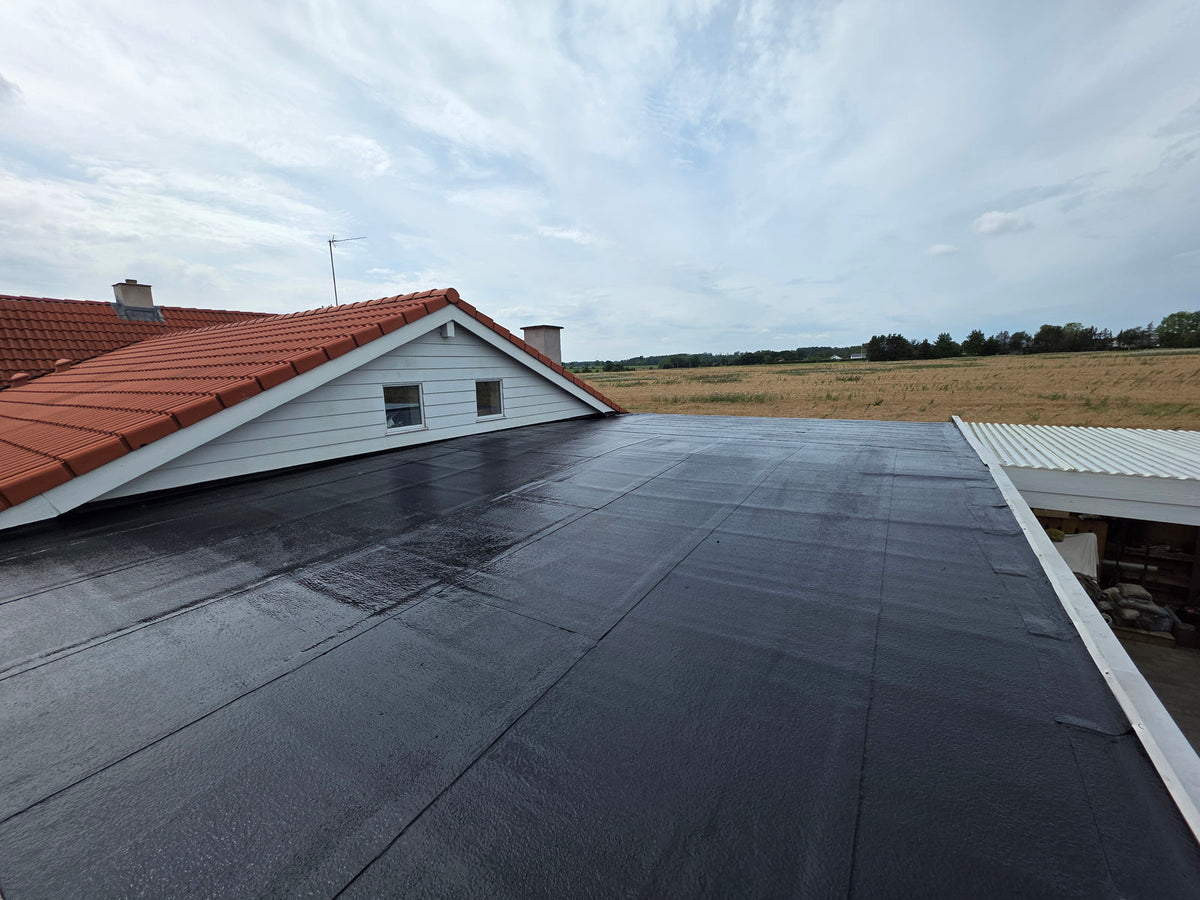
Black roof membrane carried right up to the transition towards the gable of the house.
When it's not a DIY job
A new flashing seals the transition, but it doesn't do anything about a chimney that is crooked or a foot strap that has rotted under the flashing. If this is the case, it must be fixed first. We have written about those cases in Leaky roof? How to find the hole.
Also get hold of a professional if:
- the insulation around the chimney is wet, or the wood in the rafters and sub-ceiling is soft or dark
- the roof is steep and you cannot stand safely up there
Wet wood and wet insulation need to dry before anything close comes over, and without proper securing, a steep roof is a task for a roofer.
Send us a picture first
Send us a picture of the chimney up close and one from a distance kontakt@luna-roof.dk, or write to us at the contact page. We will then tell you whether it is MaxFlex or roof membrane that you need.